You’re third in a convoy on a dirt track, the lead vehicle stops dead, and you need to tell the others before someone runs up the back. You pull out your phone. No bars. Of course there’s no bars.
That’s the moment a UHF radio earns its keep. It doesn’t care about phone towers. It talks vehicle to vehicle, crew to crew, straight over the air, in exactly the places your phone gives up.
Out here that’s not a nice-to-have. On a work site, in a convoy, or anywhere past the edge of mobile coverage, it’s how people stay safe and stay coordinated. The catch is that a radio only works as well as it’s installed, and a handheld tossed on the seat is not the same as a radio fitted and tuned properly.
Getting that right is what GFM Mechanical & Auto Electrical does. Here’s what’s involved and how to get a radio that actually reaches.
When the phone’s got no bars, the radio still works
A phone needs a tower. Drive far enough from one and it’s a paperweight for calls. A UHF radio doesn’t need any of that infrastructure. It transmits directly to other radios in range, which is why it’s still the standard for vehicle communication off the beaten track and on work sites where coverage is patchy and reliability matters.
It’s also instant. No dialling, no waiting for it to connect. You key the mic and you’re talking to everyone on the channel at once. For a convoy, a crew spread across a site, or a vehicle that needs to reach site control, that immediacy is the whole point.
None of that changes the fact that range and clarity come down to the gear and the install. A good radio fitted badly performs worse than a modest one fitted well.
When a fitted radio actually makes sense
Plenty of people get by on a cheap handheld for a while. There’s a point where a properly fitted radio stops being a luxury and starts being the obvious call.
It makes sense when you’re regularly out of phone coverage and need reliable contact. When you travel in a group and want to talk between vehicles without shouting out the window. When you work a site that runs on radio. And when safety depends on being able to reach someone, which is most of the time once you’re remote.
If you’re only ever in town with full signal, you probably don’t need one. The moment you’re past coverage with other people relying on you, it’s worth doing properly.
Handheld versus fixed-mount
This is the question most people are actually asking, so here’s the straight version.
A handheld is convenient and cheap. It’s fine for short range, around camp, or as a backup. The problem is the small antenna and the low power. Range drops off fast, especially in hills, bush, or anywhere with obstacles between you and the other radio.
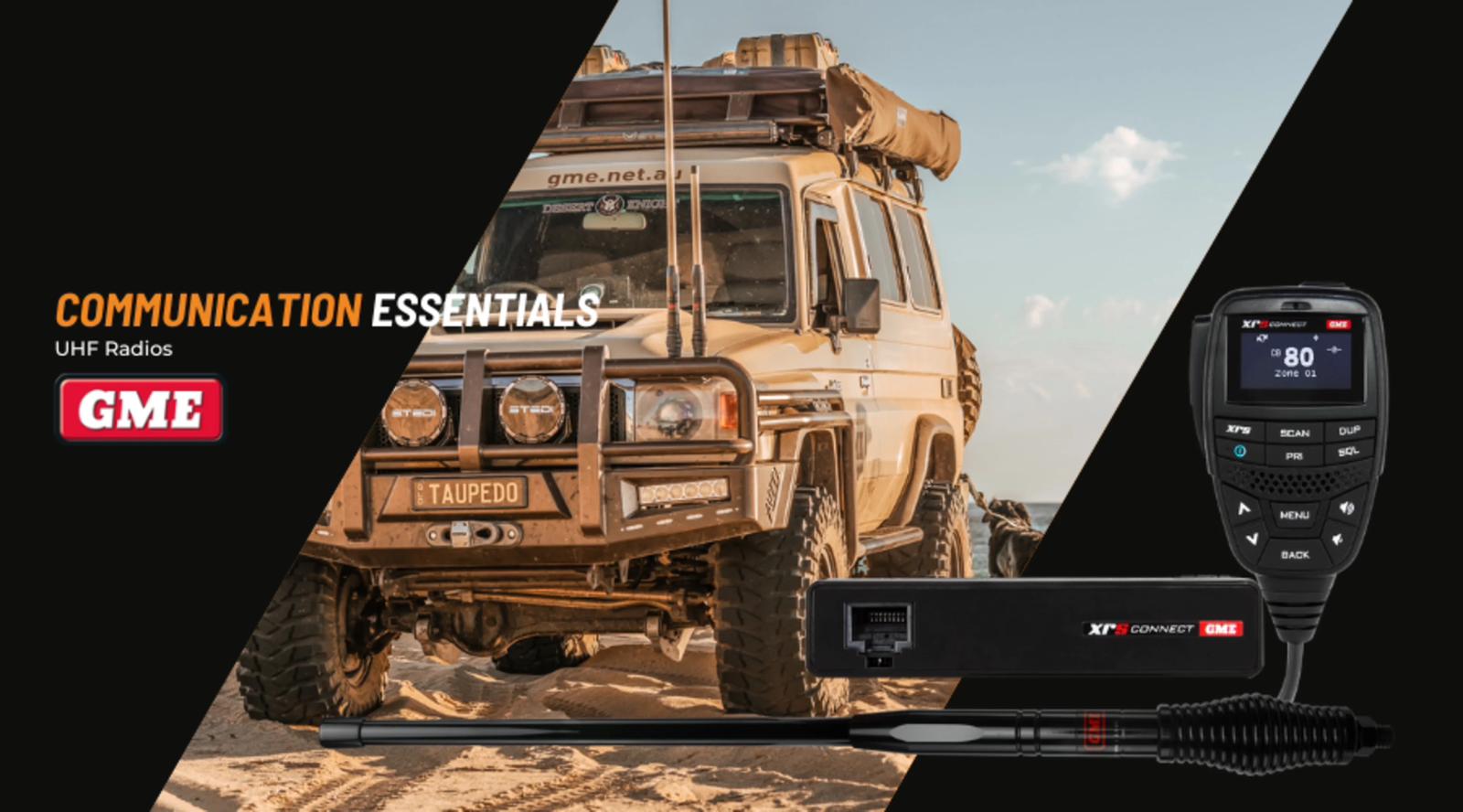
A fixed-mount radio fitted to the vehicle, with a proper external antenna, is a different animal. More power, a far better antenna up high and in the clear, and a setup that’s there and working every time you start the vehicle instead of flat in the glovebox. For anyone serious about range and reliability, fixed-mount wins every time.
The radio does the talking, but most of the real-world performance comes from the antenna and where it’s mounted, which is the part people underestimate.
The antenna is half the job
You can put a top-end radio in and still get poor range if the antenna is wrong or badly placed. The antenna is genuinely half the performance.
Two things matter most. The first is the type of antenna for where you drive. A lower-gain antenna spreads the signal up and out, which suits hilly country, bush, and undulating terrain where you need to reach over and around obstacles. A higher-gain antenna pushes the signal flatter and further, which suits open, flat country where you want maximum distance. Pick the wrong one for your terrain and you’ve kneecapped the radio before it’s said a word.
The second is mounting. The antenna wants to be up high and clear of the body of the vehicle, with the cable routed cleanly and the connection solid. A poorly mounted antenna, or one half-blocked by the roof or a rack, throws away range no matter how good the radio is.
We help you pick the right antenna for how and where you actually use the vehicle, then mount and tune it so the radio transmits at full strength. That tuning step is one most people skip, and it’s the difference between a radio that reaches and one that just looks the part.
We see it all the time. Someone spends big on a top-shelf radio, bolts the tallest antenna they can find on it, and gets worse range than the mate next to them running a mid-range setup. The reason is almost always the antenna choice or where it’s mounted. A high-gain antenna in hilly country shoots the signal flat over the top of the hills instead of down into the valleys where the other vehicles are. Or the antenna’s tucked in behind a roof rack, half-shielded by metal. The radio’s doing its job. The signal’s being thrown away before it even leaves the vehicle.
What a proper install includes
A fitted radio is a few things done right, not just a unit screwed to the dash.
Power. Wired to a stable source so it’s reliable, and where the load calls for it, run off a dual battery system so the radio and your other gear aren’t fighting the starting battery.
Antenna selection and mounting. The right antenna for your terrain, mounted high and clear, cable routed and protected.
Head unit placement. The radio and mic put where you can actually reach and read them while driving, not jammed somewhere awkward.
Tuning. The antenna tuned so the radio’s transmitting properly, not bleeding power or running weak.
Programming. Channels set up for how you use it, whether that’s the standard channels for touring and convoys or specific channels for a work site.
Testing. Checked on the air before you leave, so you know it reaches.
How the radio’s powered is worth a thought too. Wired to switch on with the ignition, it can’t be left on to flatten the battery, but it’s also off when the engine is. Wired to constant power, it’s there whenever you want it, which suits a work vehicle or a camp where you want the radio on without the engine running. Where there’s other gear in the mix, running it off a second battery takes the question off the table entirely. We set it up to match how you actually use the vehicle, rather than picking one and hoping it suits.
Programming for work and mine sites
Recreational use is straightforward. Work and site use is where programming earns its place.
Sites run on specific channels, and a radio that isn’t set to the right ones is no use at the gate or on the job. We program radios to the channels your site or crew uses, set up scanning where it helps, and make sure the radio does what the site expects. This is a core part of getting a vehicle ready for site, where the radio goes in alongside the rest of the safety gear.
If your site requires proof the radio’s programmed correctly, that’s something to sort with the site, and we’ll set the radio up to match the spec you give us.
Who we fit radios for
4×4 and touring groups. Anyone travelling in convoy or heading past coverage who wants reliable vehicle-to-vehicle contact instead of a handheld that barely reaches.
Trades and work crews. Builders, earthmovers, and crews who need to talk across a job without phones, often alongside other gear you want fitted at the same time.
Mining and civil fleet. Vehicles that need a radio programmed to site channels and fitted to a standard, as part of fleet work or a site fit-out.
Solo remote workers and travellers. People out on their own who want a reliable way to reach others if something goes wrong.
A few things to sort before we fit it
A little prep makes the install smoother and the result better.
- Have your radio ready, or know what you’re getting. Since you supply the hardware, sorting that first keeps things moving, and we’re happy to advise on what suits.
- Think about where you mostly drive. Hilly and bush country versus open flat country changes which antenna is right.
- Have a think about where you want the radio and mic so they’re easy to reach.
- Tell us what else is running off your electrical system, since the radio shares the load.
You don’t need all the answers. We’ll work through the rest together.
Radio installs across Perth
We’re a mobile auto electrical service across the Perth metro, so we fit and tune your radio where the vehicle is, rather than tying it up at a workshop.
We look after businesses around Balcatta and the trade pockets nearby, along with 4×4 owners and crews right across the metro. Not sure if we reach you? Just ask when you call.
Frequently asked questions
Do you supply the radio or do I? You supply the radio. There’s good gear out there at a range of prices, and the right one depends on how you use it. Our job is fitting it, choosing and mounting the right antenna, tuning it, and programming it. Glad to point you toward what suits before you buy.
Why is my handheld’s range so bad? Small antenna and low power. A handheld is fine up close, but range drops off quickly with any obstacles in the way. A fixed-mount radio with a proper external antenna is a big step up in both range and reliability.
What antenna do I need? It depends on your terrain. Lower gain for hilly and bush country, higher gain for open flat country. Picking the right one for where you actually drive matters more than most people realise, and we’ll help you get it right.
Can you program it for my work site? Yes. We set radios to the channels your site or crew uses, and set up scanning where it helps. If your site has a specific spec, tell us and we’ll program to it.
Will the radio drain my battery? On standby it draws very little. Where it’s part of a bigger load with other gear, we run it off a second battery so nothing touches your starting battery. We’ll work that out based on what else you’re running.
My radio stopped working. Can you look at it? Yes. Sometimes it’s the antenna or the connection, sometimes it’s a power or wiring issue. We can sort out an electrical problem with an existing setup and get it transmitting again.
Can you fit a radio at the same time as other gear? Absolutely, and it’s the tidy way to do it. Planning the radio in with extra lighting or other accessories means the whole load is balanced and the wiring stays clean.
Do I need an aerial mounted outside, or can it go inside? For real range, outside and up high. An internal aerial is heavily compromised by the body of the vehicle. We’ll mount it where it performs and route the cable cleanly.
Get your radio fitted and working
A radio is only worth having if it reaches when you need it. That comes down to the right antenna, the right mounting, and a proper tune, not just the unit on the dash.
Have a chat with us on 0456 311 406, tell us how and where you use the vehicle, and we’ll fit a radio that actually talks. If you want a look at our other services while you’re at it, they’re all there too.