You turn the key and nothing happens. Or the engine light comes on, then disappears, then comes back next week. Or your battery is dead again, even though it was fine yesterday.
Electrical faults are the most frustrating problems a vehicle can throw at you, because half the time they don’t stay broken long enough for anyone to see them. You take it somewhere, it behaves perfectly, they shrug, you pay for the privilege, and a week later you’re back where you started.
That’s what auto electrical diagnostics is for. Not guessing. Not swapping parts until something works. Actually finding the fault and proving where it is before anyone starts replacing anything.
This page walks through what diagnostics covers, how the fault actually gets found, and what to expect when you book it in with GFM Mechanical & Auto Electrical here in Perth.
When your vehicle has an electrical gremlin
Modern vehicles run on electricity far more than people realise. Your engine, your dash, your windows, your sensors, your safety systems, even your fuel and air mixture are all controlled by a web of wiring, modules, and little computers talking to each other.
When one part of that web has a bad connection, a worn wire, a tired component, or a module that’s started misbehaving, the symptoms often show up somewhere completely different to the actual cause. A faulty earth can throw a warning light that has nothing to do with the real problem. A tiny short can drain a battery overnight. A corroded plug can make a perfectly good part look broken.
So the symptom you can see is rarely the fault. The fault is hiding upstream. Finding it is the whole job, and it’s a skill, not a parts swap.
A good example is earthing. A lot of the odd electrical faults on older vehicles trace back to a bad earth, a connection to the body that’s quietly corroded over the years. The part everyone wants to blame is usually fine. The earth feeding it isn’t. You’d never find that by swapping parts, because the part was never the problem in the first place.
What auto electrical diagnostics actually covers
Auto electrical diagnostics covers any fault that lives in the electrical side of your vehicle. That’s a wide net, so here’s the honest version of what comes through the door most.
The faults we trace most
No-start and hard-start problems. The vehicle cranks but won’t fire, or won’t crank at all. Could be the battery, the starter, the alternator, a relay, an immobiliser, or wiring between any of them. Diagnostics tells you which.
Parasitic battery drains. The classic “my battery keeps going flat” problem. Something is pulling power while the vehicle is off. Could be an accessory wired in badly, a stuck relay, a faulty module, or a dodgy aftermarket install. We measure the draw and trace it back to the source.
Warning lights that won’t clear. Check engine, ABS, airbag, traction control, battery light. Sometimes it’s a real fault, sometimes it’s a sensor reporting bad information. Either way you want to know which before you spend money.
Charging system faults. The alternator not charging properly, overcharging, or charging intermittently. This one quietly kills batteries and leaves you stranded, so it’s worth catching early.
Wiring and short circuits. Chafed wires, melted insulation, corroded connectors, blown fuses that keep blowing. Common on older vehicles, 4x4s that have been off-road, and anything with a few aftermarket bits added over the years.
Accessory and aftermarket faults. Lights, fridges, winches, radios, and gear that worked when it was installed and then stopped, or started causing problems for the rest of the vehicle. A lot of this traces back to how it was wired in the first place.
Intermittent faults. The worst kind. Works fine when you bring it in, plays up the moment you leave. These take patience and the right equipment, which is exactly why a proper diagnosis matters.
How we actually find the fault
Anyone can plug a code reader into your car and read out a number. That’s not diagnostics. That’s the first thirty seconds of it.
Here’s how the fault actually gets found.
First, we talk to you. When does it happen, how often, hot or cold, moving or parked, what changed recently. You know your vehicle better than any tool does, and that conversation usually points us in the right direction before we touch anything.
Then we try to see the fault for ourselves. Where we can replicate it, we do, because a fault you can watch is a fault you can trace.
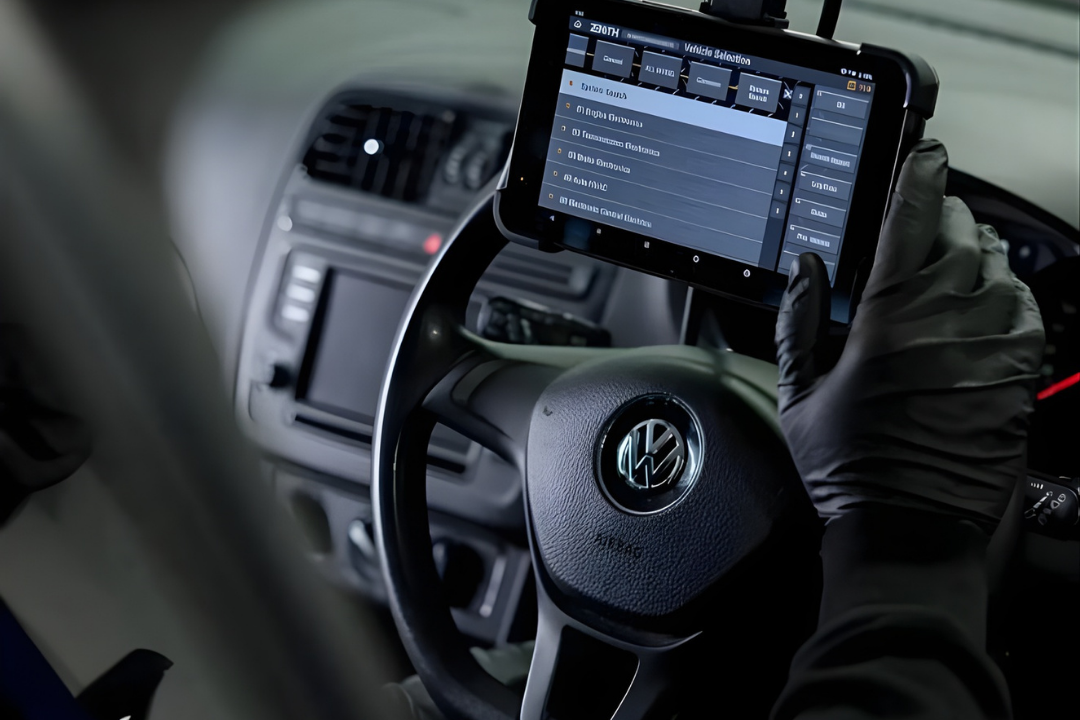
From there it’s the tools. Scan tools to read what the vehicle’s own computers are reporting, multimeters to measure voltage and resistance at specific points, and an oscilloscope for the faults that only show up as a flicker. We work off wiring diagrams for your specific vehicle, so we’re testing the actual circuit, not guessing at it.
The point of all this is to isolate the fault to a single component or a single section of wiring, and to prove it before we recommend a fix. When we tell you what’s wrong, we can show you why.
Take a battery that keeps going flat overnight, which is one we get called out for constantly. The temptation is to keep buying new batteries. But a healthy battery going flat while the vehicle is parked means something is drawing power it shouldn’t. So we measure that draw with everything switched off, then pull fuses one at a time and watch the reading drop, until the circuit causing it shows itself. From there it’s narrowing down to the actual component on that circuit. That’s twenty minutes of methodical testing instead of three new batteries and a guess. It’s the whole difference between fixing a symptom and fixing a fault.
Then you get a clear explanation and a quote. No surprises, no “we’ll just replace this and see.”
Who needs auto electrical diagnostics
Plenty of different people end up needing this, and the vehicle usually tells you when.
4×4 and touring owners. Off-road work shakes wiring loose, lets water and dust into connectors, and stresses anything that’s been added on. Electrical gremlins come with the territory.
Vehicles with a dual battery or charging setup. Anything running a second battery, a fridge, lights, and a charging system has a lot going on electrically, and a lot that can go wrong.
Fleet and work vehicles. A ute that won’t start is a day lost. Catching electrical faults early keeps the fleet moving, and a proper diagnosis stops the same fault coming back next month.
Mining and civil vehicles. Heavily fitted-out vehicles with beacons, radios, isolators, and work lights have far more wiring than a standard car, and far more that can develop a fault.
Everyday drivers. A daily that won’t start before work, or a battery light that just came on, is exactly what diagnostics is for.
A few things worth checking before you call
You don’t need to fix anything yourself. But a couple of minutes of looking can make the diagnosis faster and cheaper, so it’s worth a quick check.
- Note exactly when the fault happens. First start of the day, after it’s been sitting, only when it rains, only on bumps. Patterns are gold.
- Check whether anything was added or worked on recently. A new stereo, a fridge, a tow bar wired in, a service last month. New problems often follow new work.
- Have a quick look at your battery terminals. Heavy white or green crust around them is a sign worth mentioning.
- Notice whether the problem is getting worse, staying the same, or coming and going. That tells us a lot about what kind of fault it is.
Write it down if you can. The more you can tell us, the quicker we find it.
Diagnostics across Perth
We’re a mobile auto electrical service, so we come to you across the Perth metro area rather than asking you to limp a vehicle that might not start to a workshop. That’s the whole point. A flat or non-starting vehicle is hard to move, so we bring the diagnostic gear to the driveway, the job site, or wherever the vehicle has decided to stop.
We help customers right across the metro, from the northern suburbs through to the city and beyond, including the Osborne Park area and the trade and industrial pockets around it. If you’re not sure whether we cover your spot, just ask when you call.
Why people get us to find the fault
There are plenty of people who can read a fault code. Fewer who can actually trace a problem to its source and explain it to you in plain English.
At GFM Mechanical & Auto Electrical, we do a lot of work on 4x4s, work utes, and heavily fitted mining and civil vehicles, which means we see complicated electrical setups all day. A vehicle with a dual battery system, a winch, a radio, and a stack of lights is a normal Tuesday for us. That experience matters, because the more wiring there is, the more places a fault can hide.
We also tell you straight. If it’s a five minute fix, we’ll say so. If it’s a bigger job, we’ll show you why before you commit. The goal is that you understand what’s wrong and trust the fix, not that you walk away confused with a big bill.
If diagnostics turns up something bigger, like a charging problem, a dual battery setup that needs sorting, or accessories that were never wired properly, we can handle that too. You can see the full list of services we offer to get a sense of the range.
Frequently asked questions
How long does an electrical diagnosis take? It depends entirely on the fault. A clear, repeatable problem can be traced quickly. An intermittent fault that only shows up now and then takes longer, because we have to catch it in the act. We’ll give you a realistic idea once we’ve heard the symptoms.
Why can’t you just tell me the cost up front? Because diagnostics is the part that tells us the cost. Quoting a repair before we know what’s broken is guessing, and guessing is how people end up paying for parts they never needed. Once we’ve found the fault, you get a clear quote.
My mechanic couldn’t find the problem. Can you? Often, yes. General mechanics are excellent at mechanical work, but electrical faults are a specialty. Tracing wiring, testing circuits, and reading what the vehicle’s computers are reporting is a different skill set with different equipment behind it.
The warning light went off on its own. Do I still need it checked? Worth thinking about. A light that clears itself usually means the fault is intermittent, not gone. It’s likely to come back, often at a worse time. Catching it while it’s quiet is easier than chasing it later.
Can you diagnose faults on my aftermarket accessories? Yes. Lights, fridges, radios, winches, dual battery setups, all of it. A lot of accessory faults trace back to the original wiring, so this is common work for us.
Do I need to bring the vehicle to you? No. We come to you across Perth. For a vehicle that won’t start, that’s a big help, since moving it is half the battle.
Will you just replace parts until it works? No. The whole point of diagnostics is to find the actual fault first so the right thing gets fixed once. Throwing parts at a problem is expensive and often doesn’t fix it.
Get the fault found properly
If your vehicle has an electrical fault that nobody can pin down, the answer isn’t another parts swap. It’s a proper diagnosis that finds the cause and proves it.
Give us a call on 0456 311 406, tell us what the vehicle is doing, and we’ll come and find it. You can also read a bit more about how we work if you’d like to know who you’re dealing with first.